Air Source Heat Pumps Explained (UK, 2026)
How air source heat pumps actually work, what a realistic SPF looks like in a UK home, the R32 to R290 transition, and where the technology has got to in 2026.
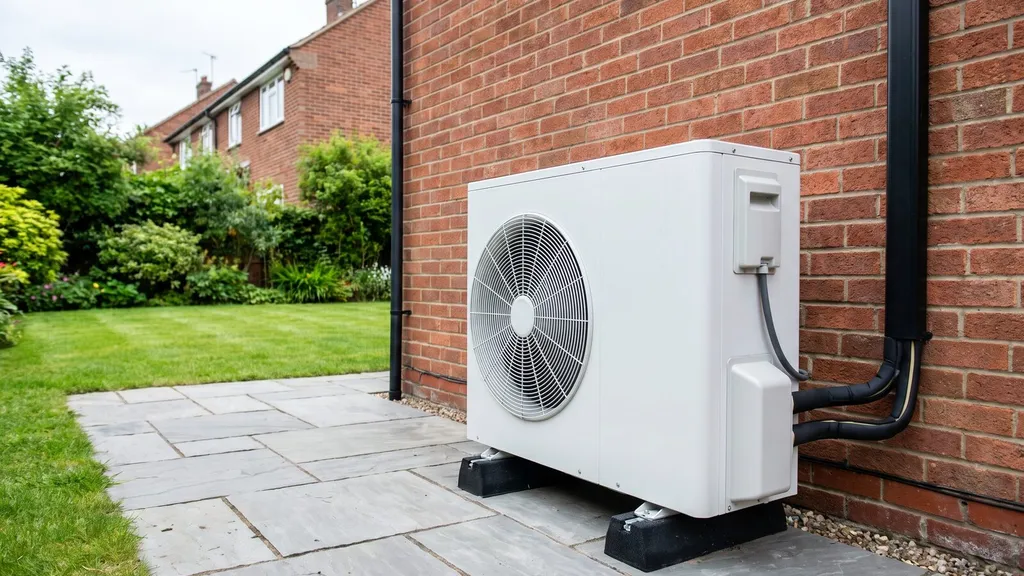
An air source heat pump (ASHP) takes low-grade heat out of the outside air and moves it into your home. Even when it's cold outside, there's still plenty of usable thermal energy in the air — modern units operate down to −25°C. They use a vapour-compression cycle (the same physics as a fridge or air conditioner) to lift that low-grade heat to a useful temperature for radiators or underfloor heating, and to top up your hot water cylinder.
The output you get from a heat pump is typically 3–4 times the electricity it consumes. That multiplier — its Seasonal Performance Factor or SPF — is the whole reason heat pumps make sense economically.
How an ASHP actually works
- Evaporator — a large finned coil at the back of the outdoor unit. A fan pulls outside air across the coil. Inside the coil is liquid refrigerant at a very low temperature.
- Refrigerant boils — even on a cold day, the outside air is warmer than the refrigerant, so heat flows into the coil. The liquid refrigerant evaporates into a gas, absorbing energy as it does so.
- Compressor — a pump-like unit squeezes the gas. As pressure rises, so does temperature. By the time it leaves the compressor, the gas is hot — typically 60–80°C.
- Condenser — a heat exchanger transfers that heat into the water flowing around your central heating circuit. The refrigerant cools and condenses back to a liquid.
- Expansion valve — the high-pressure liquid passes through a restriction that drops its pressure, dropping its temperature too. It's now ready to absorb heat again — and the cycle repeats.
Everything is sealed and runs continuously while the system is calling for heat. The compressor is the only moving part most homeowners ever hear, and modern inverter compressors run at variable speed — they ramp up and down to match demand rather than blasting on and off.
What's a realistic SPF?
Manufacturer brochures quote Seasonal Coefficient of Performance (SCOP) — a laboratory figure measured to EN 14825. Real-world performance is measured as Seasonal Performance Factor (SPF), which includes everything — control losses, defrost cycles, immersion top-ups, the works. These are different numbers and the gap matters.
DESNZ's Electrification of Heat (EoH) demonstration project monitored 742 UK heat pumps and found an average gap of around 1.0 between declared design SCOP and in-situ SPF for ASHPs installed in 2022. The Viessmann "Top of the SCOPs" 2024–25 competition (real billing-grade data from real homes) had finalists averaging SPF 4.1, with joint winners at 4.5. The wider public dataset at heatpumpmonitor.org averages around SPF 3.87.
The honest expectation, by design flow temperature:
- 35°C flow (underfloor heating, oversized rads): declared SCOP 4.5–5.0, real-world SPF 3.5–4.3 with good commissioning
- 45°C flow (well-sized radiators, proper retrofit): declared SCOP 3.8–4.5, real-world SPF 3.0–3.8
- 50°C flow (most retrofits without major rad upgrades): declared SCOP ~3.6 in the MCS Product Directory average
- 55°C flow (existing rads, no upsizing — a sign of skipped design): declared SCOP 3.0–3.6, real-world SPF 2.5–3.2
- 65°C+ flow (genuine high-temp retrofit): declared SCOP ~2.8–3.0
The single biggest variable is commissioning, not the brand
The DESNZ EoH data is clear: a well-commissioned mid-range unit will outperform a poorly commissioned premium unit, every time. Weather compensation curve set properly, design flow temperature actually delivered, system balanced, no factory defaults left in place — these are the things that decide whether you end up with SPF 3.6 or SPF 2.6.
The refrigerant transition: R32 to R290
UK ASHPs are mid-way through a generation change. The volume refrigerant for the last 5 years has been R32; the future-standard for new launches is R290 (propane). Here's why it matters for what you buy in 2026:
| Refrigerant | GWP | Max Flow Temp | Status |
|---|---|---|---|
| R410A | 2,088 | ~55°C | Phased out for new product launches |
| R32 | 675 | 60–65°C | Current volume refrigerant |
| R290 (propane) | ~3 | 70–75°C | Future-standard — fast adoption 2024–26 |
R290 has two big practical advantages over R32:
- Higher flow temperatures without efficiency collapse — R290 units routinely deliver 70–75°C flow while retaining usable COP. R32 above 55–60°C drops off badly. This is huge for retrofits where radiator upsizing is undesirable.
- Much lower GWP — R290 has a Global Warming Potential around 3, versus 675 for R32. Future-proof against tightening F-Gas regulations.
R290 is also flammable (A3 classification), so manufacturers and installers follow specific siting rules — minimum distances from openings, ignition sources and drains. MCS has published R290-specific protection-zone guidance. In practice this is a design and install discipline, not a homeowner concern, but worth knowing about.
R290 units shipping in the UK in 2026 include:
- Vaillant aroTHERM plus (3.5–12 kW; the first major UK R290 unit, launched 2021)
- Mitsubishi Ecodan R290 (5/6/8.5/10/12 kW; UK-manufactured)
- Viessmann Vitocal 150-A and 250-A (up to 70°C flow)
- Samsung EHS Mono R290 Gen 7 (5/8/12/16 kW)
- Worcester Bosch Compress 5800i AW (Quiet Mark, 41.5 dB(A) outdoor)
- Grant Aerona 290 (4/6.5/9/12/15.5 kW)
- Octopus Cosy and Aira (vertically integrated R290 systems)
If your installer is recommending a brand-new R32 unit in 2026, ask why. Sometimes there are good reasons (specific model, parts availability, installer familiarity), but in many cases an equivalent R290 unit will give a better long-term result.
Performance in cold weather
"Heat pumps don't work when it's cold" is the single most persistent UK myth — and it's wrong. All major UK-sold ASHPs are rated to operate at −20°C to −25°C, and many R290 models will deliver 55°C flow temperatures at −10°C without supplementary heat.
What does happen in cold weather: capacity drops. A pump rated 12 kW at +7°C might deliver 7–8 kW at −7°C. That's why sizing to the design external temperature (typically −2°C to −4°C across most of England, lower in Scotland) is so important. An under-sized pump will switch on its electric backup heater when capacity runs short — fine occasionally, ruinous if it happens regularly.
Defrost cycles are also normal. When outdoor air is damp and below ~5°C, ice can form on the evaporator coil. Every 30–60 minutes the unit briefly reverses the cycle to melt the ice off (and the fan often stops during this). Defrost is automatic, fast, and a sign the unit is working as designed — not a fault.
Sound and siting
Modern ASHPs run at 41–54 dB(A) sound power — comparable to a fridge or quiet conversation. Outdoors at 3 m, you can usually have a normal conversation next to one without raising your voice. Indoor noise from the heat pump itself is effectively nil.
UK permitted-development rules require an installer to assess sound to MCS 020. From 28 May 2026, this tightens under MCS 020(a) to a 37 dB LAeq, 5-minute, limit at neighbour assessment positions. Reputable installers run the calculation as part of design and either pick a quieter unit, re-site, or apply for planning permission if needed.
What size do you need?
A proper room-by-room heat loss calculation (MCS standard MIS 3005-D requirement) is the only valid way to size a pump. As a very rough guide for a reasonably insulated UK home:
- 1–2 bed flat or small terrace: 4–6 kW
- 3-bed semi, average insulation: 6–8 kW
- 3–4 bed detached, average insulation: 8–12 kW
- 4+ bed detached, solid wall: 12–16 kW (consider insulation first)
- Large or hard-to-heat property: 16–22 kW — likely warrants two units or genuine fabric work
If a quote arrives without a heat loss calculation that lists every room, walk away. It's impossible to size properly without that data, and an oversized pump is almost as bad as an undersized one — short-cycling kills efficiency and shortens compressor life.
How long does it last?
Outdoor units typically last 15–20 years. Compressors are warrantied 5–10 years (5 years standard on most brands, 10 years on premium tiers like Daikin and Viessmann). The hot water cylinder lasts 15–25 years. By comparison, a gas boiler typically lasts 12–15 years.
The MCS Compliance Certificate, manufacturer warranty registration and your annual service record all live in the homeowner pack — keep them somewhere safe. Most manufacturers require an annual service to maintain warranty, similar to a boiler.
Sources & further reading
- Electrification of Heat Demonstration: Heat Pump Performance Data Analysis — Energy Systems Catapult / DESNZ
- In-Situ Heat Pump Performance Analysis of Ofgem Data 2017–2022 — RECC / GSHPA, November 2024
- Heat pumps explained: experts answer your questions — gov.uk
- Air source heat pumps: costs, savings and benefits — Energy Saving Trust
- MCS Heat Pumps — product directory — MCS
Editorial standards
How this guide was put together
Independent
Editorially independent UK guides — no sponsored content
Primary sources
Every guide cites gov.uk, Ofgem, MCS and manufacturer data
Current
Updated as schemes, prices and regulations change
Want a tailored quote?
Get free, no-obligation quotes from MCS-certified installers near you.
Get Free Quotes