Are Solar Panels Worth It in the UK in 2026?
Honest payback figures for UK solar in 2026 — with and without a battery, by export tariff and household. The maths works far better than 5 years ago.
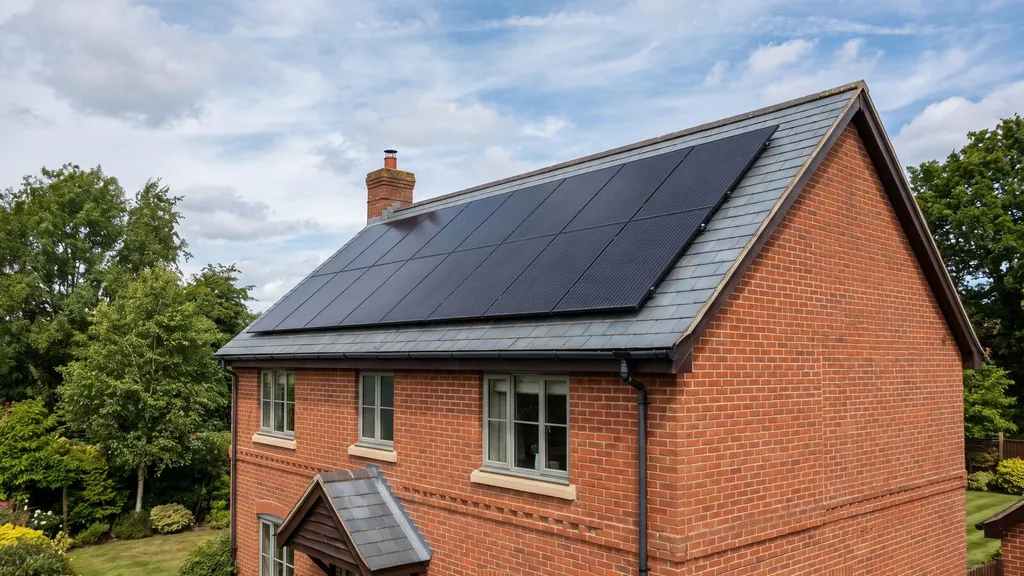
The short answer for most UK households in 2026: yes, with a 6–12 year payback depending on system size, tariff, and household pattern. The maths is meaningfully better than it was in the post-FiT slump of 2020–22 because installed costs have dropped ~20% in real terms, electricity import prices have nearly doubled, and SEG export rates have moved up off the floor.
The baseline numbers (UK, 2026)
- Yield: ~950 kWh/kWp/year on a south-facing, unshaded UK roof (Midlands typical, ~850 in the north, ~750 in Scotland)
- Import price: 24.67 p/kWh (April–June 2026 Ofgem cap)
- Export price: 12 p/kWh (Octopus Outgoing Fixed, the best no-tie-in fixed rate in 2026)
- Self-consumption (no battery): 35–45% for a typical household; higher with EV charging or heat pump
- Self-consumption (with 10 kWh battery): 70–85%
Worked example: 4 kW solar-only on a south-facing roof
- Install cost: ~£7,000 (after 0% VAT)
- Annual generation: 4 kWp × 950 = 3,800 kWh/year
- Self-consumed (40%): 1,520 kWh × 24.67 p = £375 of import bill saved
- Exported (60%): 2,280 kWh × 12 p = £274 of SEG income
- Combined annual benefit: ~£649/year
- Simple payback: 7,000 ÷ 649 ≈ 10.8 years
Run the same numbers with EV-charging-from-solar bumping self-consumption to 55% and with Outgoing Agile averaged at 15 p/kWh on the export side: annual benefit climbs to ~£820/year, payback drops to ~8.5 years.
Worked example: 4 kW solar + 10 kWh battery
- Install cost: ~£11,500 (£7,000 solar + £4,500 battery, both at 0% VAT)
- Annual generation: 3,800 kWh/year
- Self-consumed (75%): 2,850 kWh × 24.67 p = £703 saved
- Exported (25%): 950 kWh × 12 p (or 15 p+ on Agile with automation) = £114–£170 SEG income
- Combined annual benefit: ~£820–£900/year
- Simple payback: 11,500 ÷ 860 ≈ 13.4 years (or 11 years on Agile with automation)
What pushes payback down (good) or up (bad)
Down (faster payback):
- EV charging from solar (huge — daytime EV charging shifts self-consumption towards 70%+ without a battery)
- Heat pump (more daytime electricity demand for DHW in shoulder seasons)
- Home working / retired household / school-age children at home (daytime demand)
- Hot water diverter (Eddi, Solar iBoost) — pours surplus solar into the immersion at 20p/kWh effective
- Outgoing Agile + battery + automation (peak slot exports at 25–40 p/kWh)
- Future electricity price rises (real terms — most modelling assumes 2–3% real inflation in electricity prices)
Up (slower payback):
- East/west or partially shaded roof (~15–25% lower yield)
- Empty house during the day (low self-consumption, hostage to SEG rate alone)
- SEG floor rate (4.1 p/kWh basic) instead of shopping for the best
- Inverter replacement at year 12–15 (~£1,000)
- Premium panel choice for a roof that doesn't need maximum efficiency per m²
The 0% VAT cliff = strong case for installing before 1 April 2027
On 1 April 2027, VAT on solar reverts from 0% to 5% (not 20%). On a typical £7,000 system that's about £350 of additional cost. On a £11,500 solar + battery system that's about £575. Modest but real — and a useful nudge if you're sitting on the fence.
Beyond payback: the system keeps producing
Panels are warrantied 25–30 years; most still produce 85–90% of original output at year 25 and continue working for years after. Inverters typically need replacement once around year 12–15 (~£1,000). After payback, you're getting effectively free electricity (and SEG income) for the next 10–15 years.
Over a 25-year horizon, a £7,000 solar install at 10-year payback generates roughly £10,000 of additional positive return after costs — and that's before any allowance for real-terms electricity price inflation, which would push the figure significantly higher.
When solar makes less sense
- North-facing roof — don't bother
- Heavily shaded roof with no microinverter / optimiser option budget
- You plan to move house within 3–5 years — the asset value uplift typically doesn't cover the install cost over short hold periods
- Listed building or conservation area where panels would face the highway — planning permission can take 6+ months and sometimes gets refused
- Very low annual electricity use (under ~2,500 kWh/year) — absolute savings can't service the install cost on most system sizes
The 5-minute test
If three or more of these are true, solar is almost certainly worth it:
- You own the home and plan to stay 5+ years
- Your roof faces south, east or west (not north) and isn't heavily shaded
- You're home some of the day (or have an EV / heat pump that draws daytime electricity)
- Your current electricity bill is over £900/year
- You're not planning to extend or re-roof in the next 5 years
Sources & further reading
- Smart Export Guarantee Annual Report Year 5 — Ofgem
- MCS Data Dashboard — MCS
- Energy price cap unit rates — Ofgem
Editorial standards
How this guide was put together
Independent
Editorially independent UK guides — no sponsored content
Primary sources
Every guide cites gov.uk, Ofgem, MCS and manufacturer data
Current
Updated as schemes, prices and regulations change
Find out for your home
A site survey gives you a property-specific ROI figure. Quotes are free and include a yield estimate.
Get Free Quotes