Solar Battery Storage UK 2026: Costs
Home battery storage in the UK — what brands cost in 2026, how to size for your usage, and the honest case for whether a battery pays back.
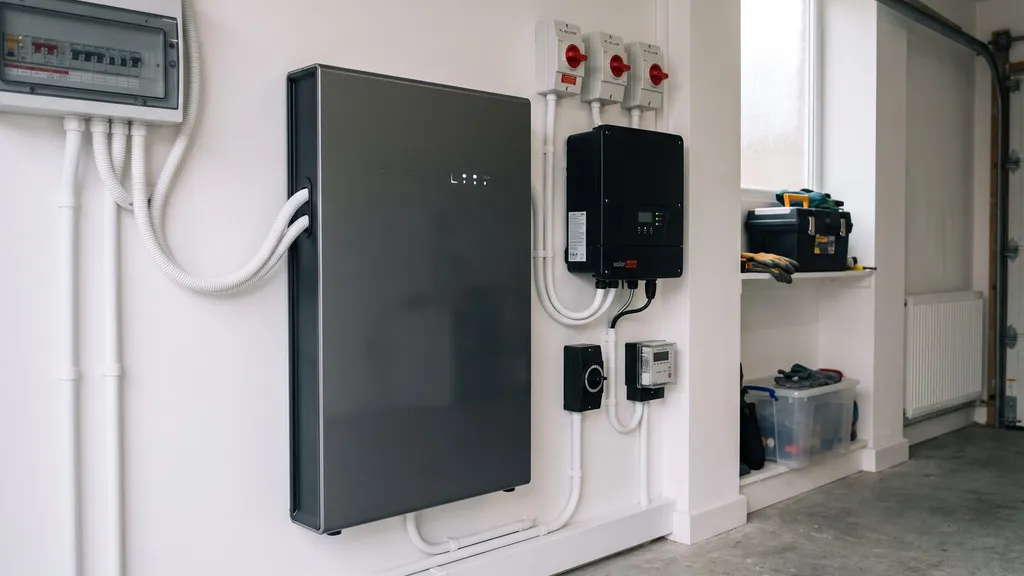
Home battery storage has gone from "nice to have if money's no object" in 2020 to a sensible addition to most new solar installs in 2026. Prices have dropped, time-of-use tariffs have proliferated, and the maths now works for many households even without solar. Here's what matters when sizing and pricing a battery in 2026.
What batteries cost in 2026
| Battery | Usable capacity | Typical UK installed price | £/kWh |
|---|---|---|---|
| Tesla Powerwall 3 | 13.5 kWh | £8,000 – £11,000 | ~£590–£815 |
| GivEnergy All-in-One | 13.5 kWh | £7,000 – £9,500 | ~£520–£700 |
| GivEnergy 9.5 kWh | 9.5 kWh | £4,500 – £6,500 | ~£475–£685 |
| Fox ESS ECS/EP | 9.5 kWh | £5,000 – £6,500 | ~£525–£685 |
| Pylontech Force (stacked) | 7–28 kWh | £3,800 – £10,000+ | Very cost-effective stacked |
| BYD Battery-Box Premium HVM/HVS | 5–22 kWh | £4,500 – £10,000+ | Modular |
Per kWh, the UK installed range in 2026 is roughly £500–£800/kWh for branded systems. 0% VAT applies (until 31 March 2027) to batteries fitted with solar, batteries retrofitted to existing solar, and — since 1 February 2024 — standalone batteries with no solar.
How to size a battery
The single biggest waste in home battery installs is over-sizing. A battery that's bigger than your daily cycle will sit at part charge and never pay back the over-capacity. As a starting point:
- 1–2 person household, modest evening use: 5 kWh — covers the typical evening peak (TV, lighting, cooking) without going much further
- Typical 3-bed family: 8–10 kWh — handles dinner, evening, and most of the night through to off-peak charging
- 4-bed+ with EV charging from solar: 10–13.5 kWh — full-day shifting, EV top-up flexibility
- Heat pump household on Cosy / Heat Pump Tracker: 10–13.5 kWh — needs to cover peak heating windows, not just lights and TV
- Off-grid or backup-focused: 13.5 kWh+ stackable — depends on critical loads
A small battery on a smart tariff often beats a big battery on a flat tariff
A 5 kWh battery on Octopus Outgoing Agile, charged from cheap overnight Agile import slots and discharged during 4–7 pm peak, can deliver £400+/year of arbitrage. A 13.5 kWh battery on a flat tariff with no automation often delivers less than half that, because the additional capacity doesn't get cycled. Tariff strategy matters more than raw capacity.
Brand and architecture choices
Tesla Powerwall 3
13.5 kWh integrated unit with a built-in hybrid inverter (the inverter is part of the Powerwall — no separate solar inverter needed in many configurations). Strong app, well-known brand, expensive. Worth it for the build quality and 10-year warranty if you value those.
GivEnergy
UK-headquartered, strong installer network, hybrid inverter + battery sold separately (more configurable). The All-in-One unit packages 13.5 kWh + inverter for a Powerwall-style install. Gen 3 inverters carry a 12-year warranty — competitive at the price.
Fox ESS
UK-popular mid-market option, especially with installers who like a modular approach. Good value, growing software ecosystem.
Pylontech
The classic budget-to-mid stacked LFP battery. Pylontech doesn't make inverters — pair with a hybrid inverter from GoodWe, Solis, Sunsynk, Growatt, or Victron (more involved off-grid). Excellent £/kWh for DIY-savvy or installer-led builds where you want to choose the inverter separately.
BYD Battery-Box
Modular Chinese-manufactured LFP, available in HVM/HVS series. Compatible with many hybrid inverters. Reliable; good for tight spaces because the modules can stack.
Lithium chemistry — LFP vs NMC
Almost every home battery sold in the UK in 2026 is LiFePO4 (LFP). LFP is chemically more stable than NMC (the older nickel-manganese-cobalt chemistry used in some older Powerwalls and many laptop/EV batteries), tolerates more charge cycles, and runs cooler. Powerwall 3 moved to LFP; Powerwall 2 used NMC. Don't pay a premium for "LFP technology" — it's the norm.
Cycle life and warranty
Most batteries are warrantied for 10 years and rated for 6,000+ full cycles. In typical UK home use, you'll do around 250–300 full cycles per year, so a 10-year warranty with 6,000 cycles is overkill — you'll be limited by warranty, not cycle life. The warranty usually guarantees the battery retains 60–70% of its original usable capacity at the end of the warranty period.
Backup vs grid-tied
Some batteries (Powerwall 3, Powerwall 3 + backup gateway, GivEnergy with EPS, Sunsynk inverters) can provide backup power to part or all of the house during a power cut. Others are purely grid-tied — they drop offline when the mains drops. Backup capability adds £500–£2,000 to the install and is usually optional. UK power cuts are rare in most areas; weigh the cost against your actual experience.
Where a battery makes financial sense in 2026
- You have solar already and your daytime self-consumption is below 40–50%
- You're on (or willing to switch to) a smart time-of-use tariff (Octopus Cosy, Intelligent Octopus Go, Outgoing Agile, EDF GoElectric)
- You're willing to configure load-shifting or use automation (Predbat, Home Assistant, manufacturer scheduling)
- Your evening peak draw is meaningful (electric cooking, EV charging, heat pump)
Where a battery struggles to pay back
- Solar-only paybacks are typically 8–10 years; adding a battery often only extends to 9–11 years if you don't actively manage the tariff
- If you're on a flat default tariff and never plan to switch to TOU, the battery is just storage for solar export, and the export tariff is the bottleneck
- If you're often away from home (battery sits at part charge, doesn't cycle)
- If your annual electricity bill is already low (< £700) — the absolute savings can't match the install cost
Standalone batteries (no solar)
Since 1 February 2024, standalone batteries qualify for 0% VAT — making "buy electricity cheaply overnight, use it during peak" a viable strategy even without solar. Typical payback on a standalone 10 kWh battery on Octopus Outgoing Agile (or similar TOU import) is 8–12 years, depending on how aggressively you manage the tariff. The bigger the spread between cheap import and expensive peak, the better the maths.
Sources & further reading
- VENSAV3061: VAT on battery storage — HMRC
- Smart Export Guarantee Annual Report Year 5 — Ofgem
- Outgoing Octopus — Octopus Energy
Editorial standards
How this guide was put together
Independent
Editorially independent UK guides — no sponsored content
Primary sources
Every guide cites gov.uk, Ofgem, MCS and manufacturer data
Current
Updated as schemes, prices and regulations change
Compare battery quotes
MCS-certified installers will spec a battery to suit your usage pattern. Get free quotes.
Get Free Quotes