Solar Planning Permission & DNO Rules (UK)
When does UK solar need planning permission? G98 vs G99 explained — how to know if your install can go ahead without delays, and how long approval takes.
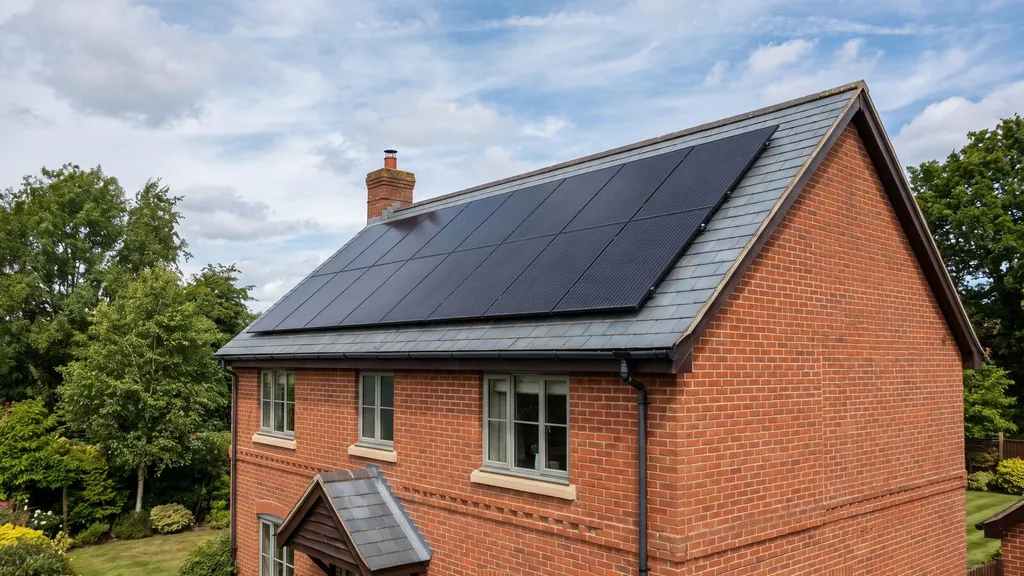
Two pieces of paperwork can hold up a solar install: planning permission (the local council's sign-off on what you put on the building) and DNO notification (the local electricity network operator's sign-off on what you connect to the grid). Most domestic installs need neither formal planning permission nor pre-approval from the DNO, but the conditions matter.
Planning permission — usually not required
Most UK domestic rooftop solar installs are permitted development — no planning permission needed — provided all of these are true:
- Panels don't protrude more than 200 mm from the roof surface
- Panels aren't higher than the highest part of the roof (excluding chimneys)
- The property is not a listed building or in a designated heritage area
- Panels aren't mounted on the principal elevation facing a highway (i.e. not on the wall facing the road) if the property is in a conservation area
- For flat roofs: panels can extend up to 600 mm above the roof since the rule change in December 2023
Listed buildings always need consent
Listed buildings always need Listed Building Consent — this isn't a planning application, it's a separate process. Local authority listed-building officers vary in their stance on solar; some are pragmatic about rear-roof installs, others very strict. Build at least 6–12 weeks into your timeline if you're going down this route.
Conservation areas and Article 4 Directions
In a conservation area, the usual permitted development rights are reduced if the panels are on a wall or roof that's visible from a highway. In most cases you can still install on the rear-facing roof under permitted development; front-facing usually needs planning permission.
Some conservation areas have an Article 4 Direction — the local authority has removed permitted development rights for solar entirely. Check with your local planning department before you commit; an installer should know whether your postcode falls into one.
Listed building rules in practice
Listed Building Consent is the test. Considerations:
- Visibility from public viewpoints — rear-roof installs typically more acceptable than front
- Reversibility — installs that don't damage historic fabric have a better chance
- All-black, low-profile in-roof systems (where panels sit flush with the roof line) sometimes pass where standard "lump on top" mounts would not
- Listed wall mounts and ground mounts are very rarely approved
DNO notification — G98 vs G99
Every grid-connected solar install must be notified to the Distribution Network Operator (the company that owns and maintains the local electricity wires). The threshold is:
- G98 — Fit and Notify: installation up to 3.68 kW per phase (16 A). Inverter rating, not panel rating. Installer notifies the DNO within 28 days. No pre-approval needed. No fee. Most single-phase domestic installs.
- G99 — Pre-installation Application: installations above 3.68 kW per phase. The DNO must approve the application before the install is commissioned. Process typically takes 2–8 weeks; longer in some regions. May incur an application fee. The DNO can require network upgrades at the homeowner's cost in some areas.
Batteries trip many installs into G99 territory
G98/G99 is assessed on total inverter export rating, not panel rating. A 4 kWp solar system with a 3.68 kW inverter is G98. Adding a 5 kW hybrid battery inverter usually pushes the install into G99 (the battery inverter is also capable of export at 5 kW). Many installer quotes don't make this clear upfront and homeowners end up waiting weeks after handing over a deposit.
Ask explicitly: "Is this install G98 or G99?" If G99, budget 2–8 weeks between deposit and commissioning for DNO approval.
Three-phase supply changes the maths
On a three-phase supply (rare in UK domestic but common in some rural / older / large properties), the G98 threshold is 3.68 kW per phase, totalling 11.04 kW before G99 kicks in. If you have three-phase, you can fit a much larger solar + battery system fit-and-notify.
Check your meter cabinet — if you have one large fuse and one meter, you're single phase. If you have three smaller fuses or three SP & N (single phase and neutral) connections, you're three phase.
Building Regulations
Solar PV installs must comply with structural, electrical and roof-loading building regs. An MCS-certified installer handles this for you under the competent person scheme — they notify Building Control on your behalf and issue an electrical safety certificate. You don't need to apply separately.
The realistic timeline
For a typical permitted-development, G98 install:
- Quote and survey: 1–2 weeks
- Deposit, scheduling: 1–2 weeks
- Install: 1–2 days on site
- DNO notification (post-install): handled by installer within 28 days
- MCS certificate: issued within 14 days of commissioning
- Total: 4–8 weeks from accepting a quote
For a G99 install, add 2–8 weeks for DNO approval before commissioning. For listed buildings or conservation areas requiring planning, add 6–12+ weeks for the council process.
What an installer should do for you
- Confirm whether your install needs planning permission (and apply on your behalf if so)
- Submit the G98 or G99 application to the DNO
- Notify Building Control under the competent person scheme
- Issue the MCS Compliance Certificate
- Register you for SEG eligibility
- Provide the handover pack with all certificates for future house sale
If your quote doesn't explicitly mention these, ask. The certificates matter not just for SEG and Building Regs compliance but for solicitor conveyancing searches when you eventually sell the house.
Sources & further reading
- Planning permission for solar panels — Planning Portal
- Engineering Recommendation G98 / G99 — Energy Networks Association
Editorial standards
How this guide was put together
Independent
Editorially independent UK guides — no sponsored content
Primary sources
Every guide cites gov.uk, Ofgem, MCS and manufacturer data
Current
Updated as schemes, prices and regulations change
Get a quote with the paperwork sorted
Good installers handle DNO notification, planning advice and MCS paperwork as part of the quote.
Get Free Quotes