Heat Pump Hot Water Cylinders Explained
A heat pump needs a special hot water cylinder with a far bigger coil than a boiler one. Why, what size you need, and the cause of running out of hot water.
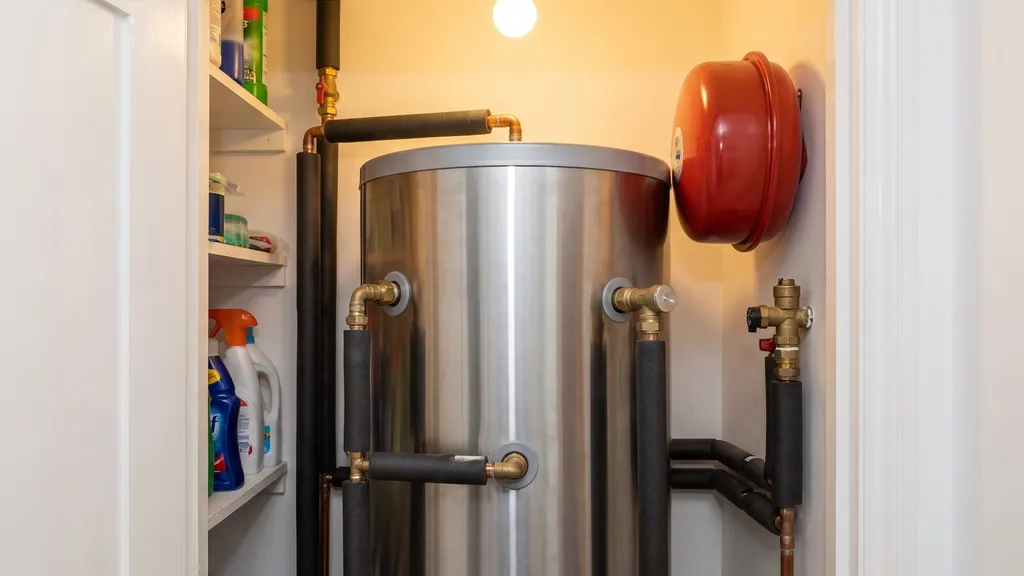
A heat pump needs a hot water cylinder with a much larger internal coil than a boiler one — typically 2.5–3.5 m² of coil surface area, versus around 1–1.5 m² in a standard boiler cylinder. The reason is simple physics: a heat pump heats water to about 50–55°C, far cooler than a boiler's 70–80°C, so it needs far more coil surface to transfer the same amount of heat. Fit a boiler cylinder to a heat pump and it reheats painfully slowly and runs the heat pump inefficiently.
Get the cylinder wrong and you'll meet the single most common heat pump complaint: running out of hot water. It's almost never the heat pump's fault — it's an undersized cylinder or coil. Here's how cylinders for heat pumps actually work, what size you need, why combi homes hit a wall, and exactly what to check on your quote.
Why a heat pump can't reheat a boiler cylinder
A gas boiler delivers heat at 70–80°C. At that temperature, a modest coil (~1 m²) transfers plenty of heat into the cylinder, reheating it in 20–30 minutes. A heat pump runs at 50–55°C — much cooler — so the same coil can't move enough heat, and reheating crawls.
To compensate, a heat-pump cylinder uses a much bigger coil (more surface area in contact with the water), so it can still transfer the heat pump's output despite the lower temperature. This is the detail that gets skimmed over — and it's exactly why you can't just keep your old cylinder.
| Boiler cylinder | Heat-pump cylinder | |
|---|---|---|
| Coil surface area | ~1.0–1.5 m² | 2.5–3.5 m² |
| Heat source temperature | 70–80°C | 50–55°C |
| Reheat time | 20–30 min | 1–2 hours |
| Will it work with a heat pump? | No — coil too small | Yes — designed for it |
Check the coil area, not just the litres
Some quotes "include a cylinder" that turns out to be a boiler-spec unit with a ~1 m² coil — cheaper for the installer, useless for a heat pump. A proper heat-pump cylinder has a coil of 2.5–3.5 m² (sometimes quoted as a high-recovery or ASHP-spec cylinder). Ask for the coil surface area in m², not just the size in litres. A big cylinder with a small coil still leaves you short of hot water.
What size cylinder do you need?
Because a heat pump reheats more slowly than a boiler, the safe approach is to size up. Running out of hot water is the top post-install regret, and a slightly larger cylinder is cheap insurance against it.
| Household | Cylinder size | Notes |
|---|---|---|
| 1 person, 1 bathroom | 170 L | Borderline for anything more than a single shower |
| 2–3 people, 1 bathroom | 210 L | The most common UK retrofit size |
| 3–4 people, 2 bathrooms | 250 L | The safe standard upgrade |
| 4–5 people, 2+ bathrooms | 300 L | Future-proof choice; bath users |
| Large / high demand | 300 L+ | Rain showers, multiple simultaneous users |
A proper MCS design (MIS 3005-D) sizes the cylinder from your actual hot water demand — number of bathrooms, baths vs showers, household routine — not a rule of thumb. But if your quote specifies a 170 L cylinder for a four-person, two-bathroom house, push back.
Why combi homes hit a wall
A combi boiler makes hot water instantly from the mains, so it has no cylinder at all. A heat pump can't do instant hot water — it's a 5–12 kW continuous device, not a 30 kW+ on-demand one — so it must store hot water in a cylinder.
That means a combi household switching to a heat pump needs to find space for a 170–300 L cylinder (roughly 1.2–1.7 m tall, 55–65 cm across) for the first time — typically an airing cupboard, utility room, loft (with frost protection), or boxed-in space. In flats and small terraces, finding that space is frequently the deciding factor in whether a heat pump is feasible at all. Homes with an existing system or regular boiler have it easier: they already have a cylinder location, so you're swapping the unit, not finding new space.
Unvented, immersion, and the Legionella cycle
- Unvented (mains pressure): heat pump cylinders are almost always unvented, so they deliver good flow at every tap and shower at the lower heat-pump temperature. Old vented (loft-tank-fed) cylinders aren't suitable.
- Immersion heater: a 3 kW immersion is standard, mainly for the weekly Legionella cycle (and as a backup). Day to day it barely runs, so it has little impact on bills.
- Legionella pasteurisation: because a heat pump runs the cylinder cooler than a boiler, a weekly cycle heats the water to 60°C+ to kill bacteria. This is automatic and built into the controls.
- Reheat time: expect 1–2 hours to fully reheat after heavy use, versus 20–30 minutes for a boiler. With a sensibly sized cylinder you won't notice; with an undersized one you'll run out.
What it costs
A heat-pump-rated cylinder typically costs £500–£1,500 for the unit, depending on size and whether it's a twin-coil (solar-thermal-compatible) or smart cylinder. It's a line item within the overall install, which averages around £13,000 before the £7,500 BUS grant. Smart cylinders (e.g. Mixergy) that heat only the volume you need can improve efficiency further, at a premium.
What to check on your quote
- Coil surface area in m² — should be 2.5–3.5 m², not a boiler-spec ~1 m²
- Capacity in litres — matched to your household (size up if in doubt)
- Unvented — for mains-pressure flow at every outlet
- Immersion heater — for the Legionella cycle and backup
- Where it's going — confirm the location and that it fits, especially coming from a combi
The cylinder is one of the most consequential and most overlooked parts of a heat pump install. Get the coil area and capacity right and you'll never think about it again. Get it wrong and you'll be cold-showering by 8am. For the full install picture, see our heat pump installation guide.
Common questions
Why does a heat pump need a special hot water cylinder?
A heat pump heats water to about 50–55°C, far cooler than a boiler's 70–80°C. To transfer the same amount of heat from cooler water, the cylinder's internal coil needs a much larger surface area — typically 2.5–3.5 m², versus around 1–1.5 m² in a standard boiler cylinder. A boiler cylinder fitted to a heat pump will reheat painfully slowly and leave you short of hot water, so a heat-pump-specific (high-coil-area) cylinder is essential, not optional.
Can I keep my existing hot water cylinder with a heat pump?
Usually not. Most existing cylinders are boiler-spec, with a small coil (~1 m²) sized for 70–80°C water. A heat pump running at 50–55°C can't push enough heat through that small coil, so it reheats slowly and the heat pump runs inefficiently. In nearly all retrofits the cylinder is replaced with a heat-pump-rated unit. If you have a system or regular boiler the location is reused; if you have a combi, you'll need to find space for a cylinder for the first time.
What size hot water cylinder do I need for a heat pump?
As a guide: 170 L for a single person/one bathroom, 210 L for a 2–3 person home (the most common size), 250 L for a 3–4 person home with two bathrooms, and 300 L for larger or high-demand households. Because a heat pump reheats a cylinder more slowly than a boiler, the rule of thumb is size up rather than down — the number-one heat pump complaint is running out of hot water from an undersized cylinder.
Why does my heat pump keep running out of hot water?
Almost always an undersized cylinder or an undersized coil. A heat pump can't reheat a cylinder in 20 minutes like a boiler — it takes 1–2 hours. So if the cylinder is too small for your household, or the coil is too small to reheat it quickly, you run out. The fix is a larger, properly heat-pump-rated cylinder. This is the single most common post-install regret, and it's a design/sizing failure, not a flaw in heat pumps.
Do heat pump cylinders need an immersion heater?
Yes — a 3 kW immersion heater is standard on a heat pump cylinder, for two reasons. First, a weekly Legionella pasteurisation cycle heats the water to 60°C+ to kill bacteria (the heat pump alone runs cooler than that). Second, it's a backup if the heat pump is ever offline. Day to day, the heat pump does the work and the immersion barely runs, so it has little effect on your bills.
Does a combi boiler home need a cylinder for a heat pump?
Yes — and it's the biggest practical barrier to heat pumps in flats and small terraces. A combi makes hot water instantly, so it has no cylinder. A heat pump can't make hot water instantly (it's a 5–12 kW continuous device, not a 30 kW on-demand one), so it must store hot water in a cylinder — typically 170–300 L, needing roughly an airing-cupboard footprint (1.2–1.7 m tall). Finding that space is often the deciding factor in whether a combi home can switch.
Sources & further reading
Editorial standards
How this guide was put together
Independent
Editorially independent UK guides — no sponsored content
Primary sources
Every guide cites gov.uk, Ofgem, MCS and manufacturer data
Current
Updated as schemes, prices and regulations change
Want it sized properly?
A good installer sizes the cylinder and coil to your household before quoting. Get free quotes from MCS-certified installers.
Get Free Quotes