Home Wind Turbines UK 2026: Worth It?
An honest UK guide to domestic wind turbines in 2026 — what they cost, how much they really generate, the planning rules, and why rooftop turbines rarely pay.
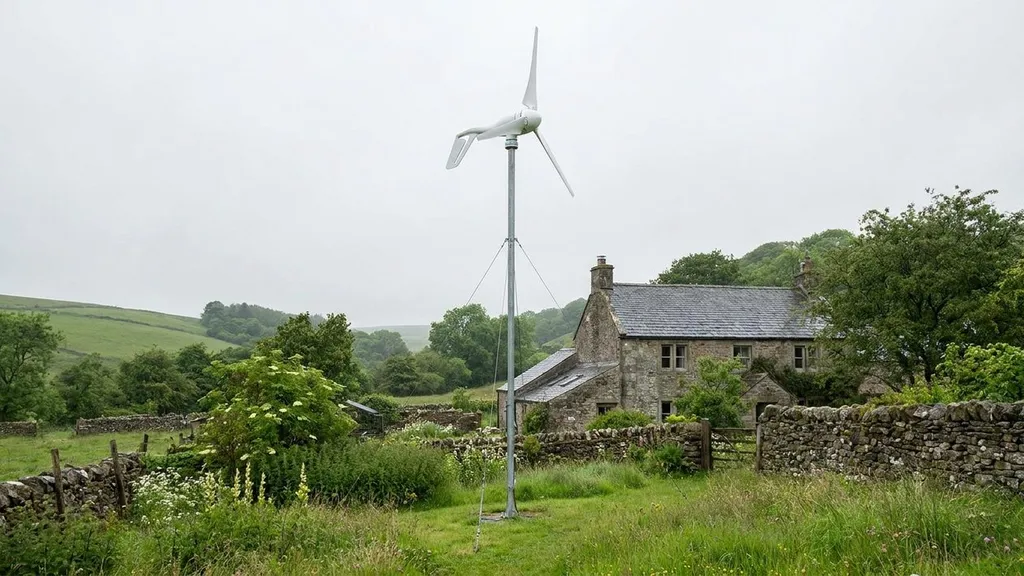
The short version: domestic wind turbines are oversold. A roof-mounted turbine on an ordinary house almost never pays — the turbulent air around buildings strangles its output. A proper pole-mounted turbine on an open, genuinely windy rural site can work, but it costs £20,000–£30,000 and only makes sense off-grid or alongside solar. For most UK homes, solar PV is the better, more predictable investment.
Search results for home wind turbines are full of £200 "6000 W" kits and decade-old guides. The reality in 2026 is more sober: wind is a brilliant technology at utility scale, but shrinking it to a single home throws away most of its advantage. Here's what actually works, what it costs, and the narrow set of circumstances where a home turbine is a sensible buy.
Roof-mounted turbines are almost always a waste of money
Air flowing over and around a building is turbulent and slowed by the structure itself. A turbine bolted to a roof sits right in that messy, low-energy airflow — so it spins erratically, generates a fraction of its rating, and transmits vibration into the building.
The Energy Saving Trust's field trials of building-mounted turbines in built-up areas found many produced so little that they barely offset the standby power of their own inverters. Wind power scales with the cube of wind speed, so a small drop in usable wind speed is a huge drop in output. If a turbine is going to work, it needs clean, fast air — which means a tall, free-standing mast, not a roof.
The two types, and why it matters
Domestic ("small") wind turbines come in two fundamentally different configurations:
- Roof / building-mounted — cheap and easy to picture, but technically poor for the turbulence reasons above. Best treated as a non-starter for grid-connected homes.
- Pole / mast-mounted (free-standing) — a turbine on a 10–15 m+ mast, sited in the open away from buildings and trees. This is the only configuration that generates worthwhile electricity, and it's what MCS-certified installers fit.
The other thing that matters more than anything on the spec sheet is your average wind speed. As a rough guide you want a site averaging around 5–6 m/s or more at hub height. Exposed coastal, hilltop and open rural plots can hit this; sheltered suburban gardens almost never do. The Energy Saving Trust and MCS both stress checking your actual site wind speed before spending anything.
What a home wind turbine costs — and really generates
| System | Typical installed cost | Realistic output/year* | Verdict |
|---|---|---|---|
| Roof-mounted micro-turbine (≤1 kW) | £2,000–£3,000 | 50–500 kWh (often far less) | Avoid — turbulence near the roof kills output |
| Small pole-mounted (1–2.5 kW) | £7,000–£12,000 | 1,000–3,500 kWh | Only on an open, genuinely windy plot |
| Mid pole-mounted (5–6 kW) | £20,000–£30,000 | 6,000–12,000 kWh | Works on exposed rural land with high wind |
| Cheap "3000–6000 W" online kits | £100–£800 | A fraction of the rating in real UK wind | Ratings assume unrealistic wind speeds — treat with caution |
*Output is entirely dependent on average wind speed. The same turbine that makes 9,000 kWh on an exposed hilltop might make a quarter of that in a sheltered valley. This is the single biggest difference from solar, where output across the UK varies by only around ±15% — wind can vary by several hundred percent between sites.
Where domestic wind actually makes sense
There is a real niche — it's just narrower than the adverts suggest. A home wind turbine is worth considering if most of these are true:
- You have an open, exposed site (rural, coastal or hilltop) with a high measured average wind speed
- You have space for a tall free-standing mast, well clear of buildings and trees
- You're off-grid or have a weak grid connection, where every self-generated kWh is valuable
- You want generation in winter and at night — wind's genuine advantage over solar, which is weakest exactly when UK demand peaks
That last point is the strongest case for wind: paired with solar PV and a home battery, a turbine fills the winter gap when solar output collapses. For a rural off-grid home, a solar-plus-wind-plus-battery system is a genuinely strong setup. For a grid-connected suburban semi, it isn't.
Planning permission and MCS
In England, a single standalone wind turbine can be permitted development — no full planning application — provided it meets the conditions, including the MCS Planning Standards for noise, a cap on blade-tip height, minimum distance from your boundary, only one turbine per property, and not being in a conservation area, National Park, World Heritage Site or near a listed building. Roof-mounted turbines and anything in a protected area generally need permission. Scotland, Wales and Northern Ireland set their own thresholds.
For the install to qualify for export payments — and to be insurable and reputable — use an MCS-certified turbine and installer. MCS certification is also the gateway to the Smart Export Guarantee.
Getting paid for what you export
An MCS-certified small wind turbine qualifies for the Smart Export Guarantee (SEG), the same Ofgem-mandated scheme that pays solar owners for surplus electricity. You'll need an export meter, and rates vary by supplier — the same league of tariffs that apply to solar export apply here. There is no separate generation subsidy for home wind any more (the Feed-in Tariff closed in 2019).
Wind vs solar for a UK home
If you're choosing where to put your money, solar wins for the overwhelming majority of homes: it's cheaper per kWh, far more predictable, simpler to get through planning, and has no moving parts. Wind only pulls ahead in specific high-wind, off-grid or rural situations — and even there it's usually a complement to solar and storage, not a replacement. Read our honest take on whether solar is worth it in 2026 before committing to either.
Home wind turbine FAQs
Is it worth having a wind turbine at home?
For most UK homes, no — especially anything roof-mounted. A domestic wind turbine only earns its keep on an open, exposed site with a high average wind speed (think rural smallholdings, not suburban gardens), and even then it needs to be a proper pole-mounted unit, not a rooftop micro-turbine. If you have a normal roof and grid connection, solar PV almost always gives a better, more predictable return for the money.
How big a wind turbine do I need to power a house?
A typical UK home uses around 2,700–3,500 kWh of electricity a year. To cover a meaningful share of that you would need a well-sited 5–6 kW pole-mounted turbine in a windy location — not a sub-1 kW rooftop unit, which in most settings generates only a token amount. Output depends almost entirely on your average wind speed, so two identical turbines on different sites can produce wildly different amounts.
How long does a domestic wind turbine take to pay for itself?
In a genuinely windy rural site, a large (5–6 kW) turbine might pay back in roughly 10–15 years. In a poor or sheltered site it may never recover its cost. By comparison, a typical UK solar PV system pays back in around 7–10 years with far less variability — which is why solar is the default home-generation choice for most people.
Can I put a wind turbine in my garden in the UK?
Often yes, but with conditions. In England a single standalone (pole-mounted) turbine can fall under permitted development if it meets the MCS Planning Standards for noise and the siting limits (one turbine only, height and distance-to-boundary rules, and not in a conservation area, National Park or near a listed building). Roof-mounted turbines and anything in a protected area usually need full planning permission. Scotland, Wales and Northern Ireland have their own rules — always check with your local planning authority first.
What are the downsides of home wind turbines?
The main ones: high upfront cost for a unit that actually works, output that is highly dependent on your specific site's wind speed, noise and vibration (worse on roof mounts), visual impact and planning friction, and moving parts that need maintenance. Rooftop turbines add a further problem — the turbulent air close to buildings means they frequently generate almost nothing.
Do home wind turbines qualify for grants or export payments?
There is no dedicated UK grant for domestic wind turbines (the Boiler Upgrade Scheme is for heat pumps; ECO4 is for insulation and heating). However, an MCS-certified small wind turbine does qualify for the Smart Export Guarantee, so you can be paid for the surplus electricity you export. In Scotland, interest-free loans through Home Energy Scotland have at times covered small wind — check the current position.
Sources & further reading
- Wind turbines — home renewables advice — Energy Saving Trust
- Small wind turbines — consumer guide — MCS
- Wind turbines — planning permission — Planning Portal
- Smart Export Guarantee (SEG) — Ofgem
- Home wind turbines — benefits, costs and requirements — HIES
Editorial standards
How this guide was put together
Independent
Editorially independent UK guides — no sponsored content
Primary sources
Every guide cites gov.uk, Ofgem, MCS and manufacturer data
Current
Updated as schemes, prices and regulations change
Solar is the better bet for most homes
For the vast majority of UK roofs, solar pays back faster and more predictably than wind. Get free quotes and compare.
Get Free Quotes