Plug-In Solar UK: Is It Legal in 2026?
Is plug-in solar legal in the UK? As of June 2026, not to just plug into a socket. The honest legal reality, the safety facts, and what it really saves.
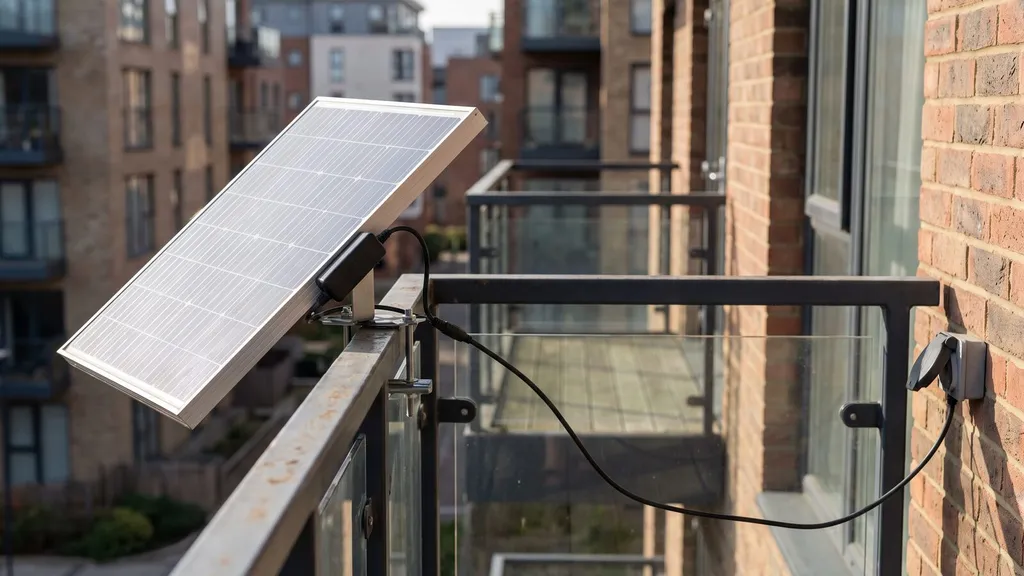
As of June 2026, plug-in solar is not legal to "just plug into a socket" in the UK — despite a wave of advertising, and competitor articles, claiming it was legalised on 24 March or 15 April 2026. You can legally buy and own a kit, but connecting one to a standard 13A socket is not compliant with the UK Wiring Regulations (BS 7671), and the IET — the body that publishes those regulations — states plainly that plug-in solar "remains not yet legal to use in the UK."
The Government has announced (24 March 2026) that it intends to change this, and has tasked BSI with writing a product safety standard expected around summer 2026. But the enabling rules aren't in force yet. So the honest position is a regulatory grey zone, not a green light — and a lot of the marketing is running well ahead of the law.
Here's what plug-in solar actually is, the real legal and safety picture, the specific false claim doing the rounds, what it genuinely saves (less than the adverts say), and the safe, compliant way to do it today if you still want one.
What is plug-in solar?
Plug-in solar — also called plug-and-play solar, or "balcony solar" after the German Balkonkraftwerk ("balcony power plant") — is a small PV system, typically one to four panels, with a built-in microinverter. The microinverter converts the panels' DC output to 230V AC and feeds it into your home through a standard 13A plug in a wall socket, back-feeding the ring or radial circuit. Whatever your home is drawing at that moment uses the free solar electricity first.
The dominant format is an 800W kit (two ~400–500W panels behind an 800W-limited microinverter), mirroring the German standard. Entry-level single-panel kits start around 300–400W. Unlike a conventional roof system, there's no MCS-certified designer or installer, no dedicated isolatable circuit, no fixed isolation switch, no DNO-approved connection, and no MCS certificate. That lack of any of the normal installation discipline is exactly why it falls outside UK rules.
The legal reality, in one table
The reason this is so confusing is that "legal" gets used to mean three different things, and the marketing blurs them together. Here's the honest breakdown:
| Question | Answer (June 2026) |
|---|---|
| Legal to buy and own? | Yes — nothing criminalises buying or possessing a plug-in solar kit |
| Legal to just plug into a socket? | No — not compliant with BS 7671 wiring regs, and the IET states it "remains not yet legal to use" |
| Compliant with the Wiring Regulations? | Only if hard-wired by a qualified electrician — a 13A-plug connection breaches Reg 551.7.2 |
| DNO notified (G98)? | A separate duty that currently falls on you, the homeowner — and is rarely flagged at the point of sale |
| Eligible for SEG export payments? | No — SEG requires MCS certification, which plug-in kits cannot get |
| Eligible for 0% VAT? | No — a plug-in appliance fails the "installed" test, so it carries 20% VAT |
The crucial distinction: UK wiring regulations govern fixed installation work, not what you plug into a socket. So there's no law you'd be prosecuted under for plugging one in — but the connection is non-compliant with BS 7671 (specifically Regulation 551.7.2, which says a generating set must not be connected to a final circuit by a plug and socket), you have an unmet G98 notification duty, and no UK-certified product yet exists. Products that say "legal in the UK" are leaning on the first row of that table while quietly ignoring the rest.
The false claim doing the rounds: 'Amendment 4 / Chapter 708 legalised it'
A lot of retailer and affiliate sites state, as fact, that BS 7671 Amendment 4 (published 15 April 2026) introduced a "Chapter 708" that legalised 800W plug-in solar. This is simply false. Amendment 4's actual contents are: a new chapter on stationary batteries (Chapter 57), an energy-efficiency chapter (Chapter 81), Power-over-Ethernet (Section 716), functional earthing for IT equipment (Section 545), and a revision of medical locations (Section 710). There is no plug-in solar provision and no Chapter 708, and the IET's own press release announcing Amendment 4 doesn't mention plug-in solar at all. Treat any site making this claim with caution — it tells you they haven't checked the primary source.
How the UK got here — the actual timeline
- June 2025: The DESNZ UK Solar Roadmap states "currently, UK regulations do not allow plug-in solar" and commits to a safety study, framing plug-in solar as a way to give renters and flats access to cheaper solar.
- July–October 2025: DESNZ commissions a Plug-in Solar PV Study (awarded to Arceio Ltd, £80,309) to assess whether plug-in PV can be safely deployed on UK ring-main circuits.
- 24 March 2026: Government press release — "plug-in solar in shops within months." It commits to work with the Energy Networks Association, DNOs and Ofgem to update the G98 grid code and BS 7671 to allow sub-800W plug-in solar "without the need for an electrician," and tasks BSI with a dedicated product standard (expected ~summer 2026). Lidl, Iceland and EcoFlow are named as retail partners. The same day, the IET cautions that it "remains not yet legal to use."
- 15 April 2026: BS 7671 Amendment 4 is published — containing no plug-in solar provision (see warning above).
- June 2026 (now): Announcement made, safety study done — but the BSI product standard is not yet published and the G98 amendment is not yet in force. The only compliant route remains a hard-wired install by a qualified electrician.
How the UK compares to Germany
Germany is where the "just plug it in" model actually works — and the contrast shows how far behind the UK is. Germany has over a million balcony solar systems installed. Its rules: inverter output limited to 800VA, panel capacity up to ~2,000W, a single online registration (the MaStR register, with the grid operator informed automatically — no separate DNO notification), and, since new standards in late 2025 and early 2026, standard Schuko plugs are normatively permitted.
The UK has the political commitment and a completed safety study, but not the in-force product standard or grid-code route that Germany has. In regulatory terms the UK is roughly nine months to a year behind. (The US is moving too: Utah became the first state to explicitly allow balcony solar in late 2025, and the UL 3700 safety standard launched in January 2026 — though no system had been fully certified to it as of spring 2026.)
What's being sold in the UK right now
Despite the legal position, kits are already on sale: EcoFlow, the UK firm Thunder Energy, Amazon listings, and the government's named retail partners Lidl and Iceland. Pricing is the genuine attraction — but watch the claims:
| Item | Typical 2026 cost |
|---|---|
| 400W single-panel starter kit | under £200 |
| 800W dual-panel kit (the mainstream) | £585 – £770 |
| Premium kit (e.g. EcoFlow) | £800 – £1,200+ |
| Compliant electrician hard-wire install | +£200 – £450 |
| Add a battery | +£700 – £900 |
| Realistic annual saving (800W, no battery) | £70 – £175/year |
| Realistic payback (compliant install) | 5 – 7 years |
The better operators are upfront that you currently need an electrician to hard-wire a kit, that no UK-certified product yet exists (CE and German VDE marks don't automatically carry over post-Brexit), that the G98 notification is your responsibility, and that the savings maths is modest. The worse ones claim it was "legalised in April 2026," imply SEG payments and 0% VAT apply (they don't), and quote "2–3 year payback" figures that assume you use 100% of the generation — a fantasy for a household that's out during the day.
Does it qualify for anything? (No)
- 0% VAT — no. The energy-saving-materials relief covers materials installed into a building with labour. A plug-in appliance you buy and plug in yourself fails the "installed" test, so it's standard-rated at 20% VAT.
- Smart Export Guarantee — no. SEG requires MCS certification and an export meter. Plug-in kits can't be MCS-certified, so anything you export goes to the grid unpaid.
- MCS certification — no. MCS covers designed, professionally installed and commissioned systems. A self-installed plug-in unit is out of scope.
- Grants — none. No UK grant covers plug-in solar.
This matters: the three things that make a conventional small solar install financially sensible — 0% VAT, SEG export income, and MCS warranty/standards — are all unavailable to a plug-in kit. See our Smart Export Guarantee guide and 0% VAT guide for what you'd be missing.
Is it safe?
The safety questions are real, and they're the whole reason the Government commissioned a study rather than just legalising it overnight:
- The "live plug" risk: if you pull the plug while the inverter is generating, could the pins be live? Compliant microinverters use anti-islanding — they shut down within a fraction of a second when disconnected from the mains. The concern is whether every uncertified product reliably does this, every time. A product standard exists precisely to guarantee it.
- RCD compatibility: the IET specifically warns that older Type AC RCDs were never designed for electricity flowing backwards through them and may fail to trip — removing your shock protection. A Type A RCD is the safer baseline.
- Circuit loading: feeding into the same circuit as high-draw appliances, or stacking two inverters into one double socket, creates loading the ring final wasn't designed for. Socket terminations are often the weak point.
- Insurance: running a non-compliant kit means operating outside the regulations, which could affect a home-insurance claim. Even once certified kits arrive, you should disclose it to your insurer — non-disclosure can invalidate cover.
The honest payback
An 800W kit in the UK generates roughly 500–800 kWh a year on a good south-facing mount (less on a vertical balcony or anywhere shaded). The problem isn't generation — it's self-consumption. Peak output is 11am–3pm, when a typical home that's out at work draws maybe 100–150W of the available 800W. Without a battery and without export payments, the surplus is given to the grid free.
Realistic self-consumption without a battery is 50–60%, which translates to annual savings of roughly £70–£175 for most households — toward the top of that range only if someone's home using power during the day. On a compliant install (kit + electrician), that's a 5–7 year payback, not the 2–3 years the adverts quote. A battery lifts self-consumption above 90% and savings toward £300+/year, but adds £700–£900 and stretches the payback again.
The compliant way to do it today
If you want plug-in solar before the rules change, do it the safe and compliant way — treat it as a micro fixed install, not an appliance:
- Have a qualified, competent-person-scheme-registered electrician hard-wire it (no 13A plug) to a dedicated, assessed circuit with a Type A RCD and proper isolation
- Get an EICR or installation-suitability check on your existing wiring first
- Have the installer notify the DNO under G98
- Tell your home insurer
That's the same discipline a conventional install uses — which rather undercuts the "just plug it in, no electrician" pitch, but it's the only route that's actually compliant and insurable in June 2026.
So should you buy one?
For most people with a roof: no — not yet. A small conventional MCS install is larger, SEG-eligible, 0% VAT, properly certified and warranted, and the per-kWh economics are better once you account for everything a plug-in kit can't claim.
Plug-in solar's genuine appeal is for renters and flat-dwellers who can't get a roof install at all — and even then, the sensible move in June 2026 is to wait for the BSI product standard and the first UK-certified, G98-simplified kits, expected later in 2026. At that point you'll be able to buy a kit that's actually legal to plug in, properly safety-tested, and covered by your insurer. Buying today means paying 20% VAT for a non-compliant device in a legal grey zone, to save perhaps £100 a year.
The technology is good and the direction of travel is clear — the Government will almost certainly enable this in the next year. The advertising is just running ahead of the law. When the rules actually change, we'll update this guide.
Common questions
Is plug-in solar legal in the UK in 2026?
Not in the sense the marketing implies. As of June 2026 you can legally buy and own a plug-in solar kit, but plugging it into a standard socket is not compliant with the BS 7671 Wiring Regulations (Regulation 551.7.2 says a generating set must not be connected via a plug and socket), and the IET — which publishes those regulations — states plainly that plug-in solar "remains not yet legal to use in the UK." The Government announced in March 2026 that it intends to change this, but the enabling product standard and grid-code amendment are not yet in force.
Did BS 7671 Amendment 4 legalise plug-in solar on 15 April 2026?
No — this is a widely repeated but false claim. Amendment 4 to BS 7671:2018 was published on 15 April 2026, but its actual contents are a new chapter on stationary batteries (Chapter 57), an energy-efficiency chapter (Chapter 81), Power-over-Ethernet (Section 716), functional earthing (Section 545) and a revision of medical-location rules (Section 710). It contains no plug-in solar provision and no "Chapter 708", and the IET's official press release about it doesn't mention plug-in solar at all. Any site claiming Amendment 4 legalised plug-in solar is wrong.
How do plug-in solar panels work?
A plug-in (or "balcony") solar kit is one to four PV panels with a built-in microinverter. The microinverter converts the panels' DC output to 230V AC and feeds it into your home through a standard 13A plug in a wall socket, back-feeding the circuit. The electricity is used by whatever appliances are drawing power at that moment. There's no battery (unless you add one) and no fixed wiring — which is exactly why it sits outside the UK's installation rules.
Can I get paid for exporting plug-in solar to the grid?
No. The Smart Export Guarantee (SEG) requires an MCS-certified installation and an export meter, and plug-in kits cannot be MCS-certified. Any electricity your kit generates beyond what your home is using at that instant is exported to the grid for free. This is the single biggest reason the real-world savings are far lower than the adverts suggest.
Do plug-in solar panels qualify for 0% VAT?
No. The 0% VAT relief on energy-saving materials (which runs until 31 March 2027) applies to materials installed into the fabric of a building with labour — typically a hard-wired solar system fitted by a qualifying installer. A plug-in appliance you buy off a shelf and plug in yourself doesn't meet the "installed" test, so it carries the standard 20% VAT (around £100 on a £599 kit).
How much do plug-in solar panels actually save?
An 800W UK kit typically generates 500–800 kWh a year. But without a battery or export payments, you only save on what you use at the moment it's generated — and peak output (11am–3pm) is exactly when many homes draw very little. Realistic self-consumption is 50–60%, giving annual savings of roughly £70–£175 for most households. Vendor claims of £200+ and "2–3 year payback" assume near-100% self-consumption, which isn't realistic for a working household. A compliant install pays back in around 5–7 years.
Is it safe to plug solar into a socket?
The main concerns are: a plug pulled out while the inverter is still generating (compliant microinverters shut down via "anti-islanding," but uncertified products may not reliably do so); older Type AC RCDs that were never designed for electricity flowing backwards and may fail to trip; and overloading a ring circuit. This is precisely why a product safety standard matters — and why, until the UK's is published, the safe route is to have an electrician hard-wire the system rather than rely on a plug.
When will plug-in solar be legal in the UK?
Likely during late 2026 into 2027. The Government committed in March 2026 to update the G98 grid code and BS 7671 to allow sub-800W plug-in solar without an electrician, and tasked BSI with creating a dedicated product standard (expected around summer 2026). A compliant "just plug it in" route should follow once that standard is in force and the first UK-certified kits appear. We'll update this guide when it happens.
Sources & further reading
- Government to make 'plug-in solar' available within months — GOV.UK, 24 March 2026
- IET urges households to check electrical safety before using plug-in solar products ("remains not yet legal to use in the UK") — IET, 24 March 2026
- Amendment 4 (2026) to BS 7671:2018 published — official contents — IET / BSI, 15 April 2026
- UK Solar Roadmap ("Currently, UK regulations do not allow plug-in solar") — DESNZ, June 2025
- Plug-in Solar PV Study — tender and award (Arceio Ltd) — DESNZ / Find a Tender, 2025
- Inside the evolving landscape of plug-in solar in the UK — Solar Power Portal
Editorial standards
How this guide was put together
Independent
Editorially independent UK guides — no sponsored content
Primary sources
Every guide cites gov.uk, Ofgem, MCS and manufacturer data
Current
Updated as schemes, prices and regulations change
Thinking about solar properly?
If you want SEG payments, 0% VAT and a system that's actually compliant, a small MCS roof install is the route. Get free quotes.
Get Free Quotes