Heat Pump Installer Shortage UK 2026
The UK's heat pump installer workforce is stretched thin. The HPA's 2026 report from 250+ installers reveals six barriers — and what they mean for you.
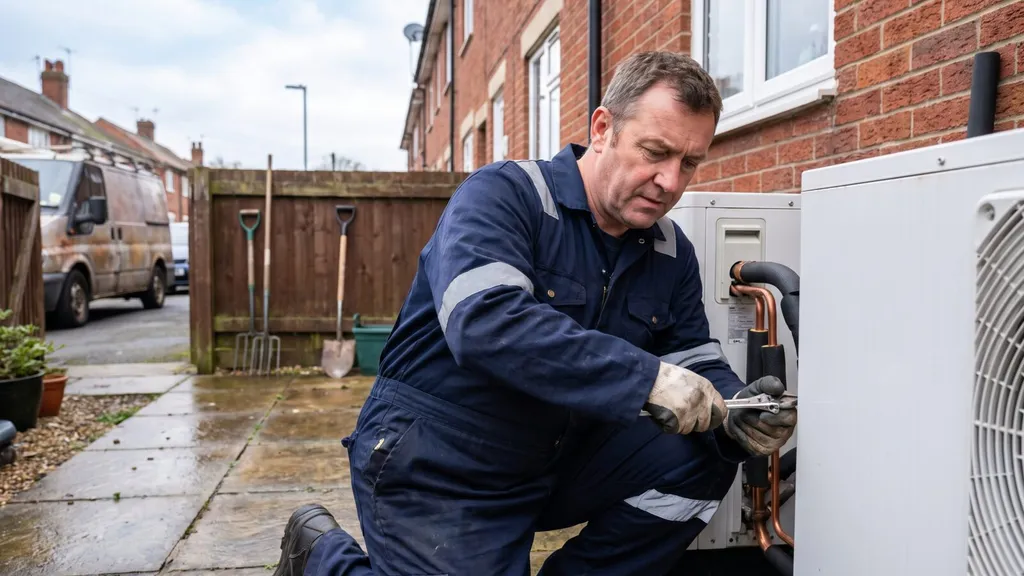
The UK heat pump installer workforce is the single biggest constraint on the country's heat pump rollout — bigger than grant funding, bigger than electricity prices, bigger than consumer awareness. A new Heat Pump Association (HPA) report published 28 May 2026, drawing on input from nearly 250 installation businesses, identifies six barriers slowing the workforce: administrative burden, electricity costs, grid connection delays, inconsistent policy signals, workforce development gaps, and consumer awareness gaps. None of these are surprises to anyone in the industry — but the fact installers are saying them collectively, with data, matters.
For homeowners, this isn't an abstract policy story. The installer-side constraints translate directly into longer wait times, wider quote spreads, narrower regional choice, and more confusion at the kitchen table. Quoted lead times of 5–9 weeks in spring stretch to 3–4 months in heating-season peaks. Quote variance of £3,000–£5,000 on near-identical specs is common. Whether the new July 2026 BUS uplift to £9,000 for oil/LPG homes accelerates capacity or just adds to the queue is the next big question.
Below: what the HPA report actually says, translated for homeowners, and how to navigate a heat pump market where the constraint is the workforce, not the kit.
The six barriers, translated for homeowners
The HPA report, with input from 250+ installers, is largely a wishlist for government — but the underlying barriers are real and affect what every homeowner getting quotes experiences. Here's how each one maps from industry-speak to your install.
| Barrier (HPA finding) | What it means for homeowners |
|---|---|
| Administrative burden | Longer quote turnaround; some installers refuse complex retrofits where MCS paperwork outweighs margin |
| Electricity costs (vs gas) | Tougher sales conversation — installers spend time explaining tariffs that should be doing the talking |
| Grid connection delays | Properties needing supply upgrades face 6–12 weeks of DNO wait before install can proceed |
| Inconsistent policy signals | Scheme rules changing mid-quote (e.g. April 2026 BUS V5 changes); confusion drives buyer hesitation |
| Workforce development gaps | Fewer installers per region = longer waits, narrower choice, less price competition |
| Consumer awareness deficit | Customers arriving with myths and bad data wastes survey time and inflates quote costs |
1. Administrative burden — the MCS paperwork problem
Installers spend significant unpaid time on paperwork — MCS design submissions, BUS voucher applications via Ofgem, building control notifications, MCS 020(a) sound assessments (newly mandatory from 28 May 2026), DNO notifications. For a £14,000 install, an MCS contractor is typically committing 8–12 hours of admin per job before the install starts.
This shows up at the homeowner end as: slower quote turnaround, refused enquiries for complex retrofits where the paperwork-to-margin ratio is poor (period properties, listed buildings, off-grid, mixed-fuel sites), and a pressure on installers to standardise jobs rather than design for your specific property. If your house is anything other than a straightforward semi or detached, expect more rejections than acceptances when you reach out.
2. Electricity-to-gas price ratio
The UK currently runs at a 4:1 electricity-to-gas price ratio on the default Ofgem cap. Heat pump running costs only beat gas decisively when (a) the install delivers a real-world SPF of 3.5+, and (b) the homeowner moves to a heat-pump-specific tariff like Octopus Cosy or EDF Heat Pump Tracker. Both of those are doable, but they're a conversation rather than a foregone conclusion.
The Warm Homes Plan technical annex (January 2026) explicitly flags the gas:electricity ratio as a barrier to heat pump uptake and signals a review — but nothing has changed operationally yet. For installers, this means every quote includes a 20-minute education session on tariffs that a decade of gas-boiler installs never needed. Multiply that across a year's worth of enquiries and it's a meaningful drain on capacity.
3. Grid connection delays
Most heat pump installs run G98 (fit-and-notify, no pre-approval) on the DNO side. But a growing minority — properties with constrained 60A main fuses, off-grid retrofits requiring significant electrical upgrades, larger ground source installs needing three-phase — trip into G99 territory, which means 2–8 weeks of DNO pre-approval before commissioning can happen.
The HPA report singles this out alongside the wider ADMD (After Diversity Maximum Demand) calculation methodology used by DNOs — installers argue current ADMD assumptions over-estimate household demand and unnecessarily push more installs into G99 reinforcement queues. For homeowners, the practical impact: if your install needs any electrical supply work, expect the timeline to stretch. Ask your installer up-front whether the job is G98 or G99, and budget accordingly.
4. Inconsistent policy signals
The BUS scheme has changed significantly four times in three years. The latest changes — BUS V5 effective 28 April 2026 — added air-to-air heat pumps at £2,500, removed the mandatory EPC requirement, and extended the scheme to 2030. The £9,000 enhanced grant for off-gas oil/LPG homes, announced 21 April 2026, then went live on 21 July 2026.
For installers, these mid-flight changes mean retraining, updating quote templates, and re-briefing the front-of-house team several times a year. For homeowners, it means quotes obtained in March may be incomplete for April's V5 rules. The Clean Heat Market Mechanism (CHMM) — which requires gas boiler manufacturers to deliver heat pump credits each year — adds another layer: Year 2 target rose to 8% from 1 April 2026, which is why several manufacturers are now running aggressive heat pump promotions. The signals are real, but the volatility is exhausting at the installer end.
5. Workforce development gaps — the actual shortage
This is the headline issue. The UK has roughly 5,000–6,000 MCS-certified heat pump installers in 2026. The Climate Change Committee's projected 600,000 heat pumps per year by 2028 would require roughly 30,000–40,000 active installers — a 5–7× scale-up in two years.
Training pipelines exist (Heat Pump Association's training accreditation, low carbon apprenticeships, City & Guilds 6281, BPEC heat pump courses) but the throughput simply can't match the targets. The HPA report is direct: workforce expansion needs sustained funding for training, not the year-by-year scheme launches that have characterised UK skills policy.
Translated for homeowners: fewer installers per region means longer waits, less price competition, and reduced quality of competition. In some rural counties, there are fewer than 10 MCS-certified heat pump installers operating, and only 2–3 doing serious volume. If you're in one of those areas, your "shop around" effectively means waiting for whichever installer can fit you in.
6. Consumer awareness deficit
The HPA flags a lack of central, impartial consumer guidance. Installers report spending significant time at quote stage correcting misinformation — that heat pumps don't work in UK winters (they do; modern units run to −25°C), that they need new radiators in every room (most retrofits upgrade 30–50%), that they're noisy (modern units are 41–48 dB(A)), that 22kW chargers are better than 7kW (a different category but the same upgrade-spec instinct).
Every minute spent disabusing a homeowner of a misconception is a minute not spent designing the system. The HPA's argument: government-funded impartial consumer guidance would reduce this burden. The reality: there is no such central source, and homeowners are largely left to navigate manufacturer marketing, installer pitches, and the wider internet. Independent guides — like this one — try to fill the gap, but a single national consumer information service would help everyone.
Why this matters for the BUS rollout
The DESNZ Warm Homes Plan committed £13.2 billion over 2025–2030 to home decarbonisation, with heat pumps the largest single line. The funding exists. The grants exist. What doesn't yet exist at sufficient scale is the workforce to do the installs. Every additional grant pound the Treasury commits without parallel workforce investment widens the gap between policy ambition and physical delivery.
How to navigate a constrained installer market
For homeowners, the practical question isn't "is there a shortage?" — it's "how do I get a good install without paying a premium for the constrained-supply market?" Here's what works:
| Step | Action |
|---|---|
| 1. Cast a wider net early | Approach 3–5 installers, not 1–2. Local independents often respond faster than national brands at peak demand. |
| 2. Have your paperwork ready | EPC (if you have one), recent energy bills, photos of your boiler/cylinder space, existing radiator schedule. Installers ranking enquiries reward complete ones. |
| 3. Be flexible on install timing | Quote in spring/summer for autumn install. Heating-season demand pushes lead times out. |
| 4. Ask about the design flow temperature upfront | A quote at 55°C+ design flow is a corner-cutting signal. A quote at 45–50°C means the installer has done the work. |
| 5. Don't chase the cheapest quote | In a constrained market, the cheapest quote often skips radiator upgrades or commissioning time. Look at design quality, not headline price. |
| 6. Confirm BUS voucher process upfront | Voucher takes 2–4 weeks via Ofgem after the installer applies. Build that into your timeline. |
The bigger picture: targets vs reality
Where the rollout actually sits in May 2026:
- 2024 total UK heat pump installs: ~57,000 (across all schemes — BUS, ECO4, social housing, private). Up from ~36,000 in 2022 but well below the 600,000-by-2028 trajectory.
- BUS-only installs Oct–Dec 2025: approximately 12,000–14,000 (DESNZ quarterly statistics, exact published figure varies).
- Average BUS-claimed install cost (latest quarter): £13,431 for an 8.4 kW air source unit.
- BUS budget 2026/27: £400 million, with up to £2,392 million committed across 2026/27 to 2029/30.
- Heat Pump Association membership: ~250 installer businesses contributed to the May 2026 workforce report — a meaningful sample of the active installer base.
The 2028 target (600,000 heat pumps/year) was set under the original Heat & Buildings Strategy in 2021 and is widely considered unattainable on current trajectory. The Warm Homes Plan (January 2026) restates the ambition but doesn't fundamentally change the delivery rate. Without a substantial workforce intervention — government-funded training, apprenticeship subsidies, conversion pathways for existing Gas Safe engineers — the gap will persist through 2028 and beyond.
When this gets better (or worse)
What we'll be watching over the next 18 months:
- July 2026 — BUS £9,000 uplift goes live. Will drive a surge in oil/LPG enquiries that the installer base will struggle to absorb. Expect lead times to extend further in late 2026.
- Autumn 2026 — Treasury fiscal events. Possible heat pump VAT relief extension (currently expires 31 March 2027); possible workforce funding announcement.
- Throughout 2026/27 — Clean Heat Market Mechanism (CHMM) tightening. Year 2 target is 8% of relevant boiler sales as heat pump credits. Manufacturers under pressure to drive demand — more promotions, more aggressive marketing, more enquiries.
- March 2027 — 0% VAT relief on heat pumps expires. Reverts to 5% (not 20%). Modest impact on prices but a real deadline driving 2026 enquiries forward.
- Early 2027 — workforce statistics watch. Will MCS heat pump installer numbers cross 10,000? At current growth trajectory, marginal — and well short of what targets require.
The honest read for a homeowner in 2026
If you're considering a heat pump and there's any flexibility on timing: quote sooner, install later. Get your installer chosen, design agreed, and BUS voucher in hand before the autumn 2026 surge. A well-designed install that lands in February 2027 is dramatically more valuable than a rushed one in November 2026.
What the HPA report wants
The HPA's six asks of government are sensible, mostly cheap, and largely well-rehearsed in energy-policy circles:
- Streamline certification and compliance — without lowering the quality bar. Reduce paperwork redundancy, not standards.
- Rebalance electricity and gas pricing — bring electricity policy costs into line with what's needed for heat pump economics to work without bespoke tariffs.
- Support training and skills development — sustained funding, not year-by-year scheme launches.
- Enhance consumer awareness campaigns — a single, government-backed, impartial source homeowners can trust.
- Simplify grid connection processes — particularly the ADMD methodology that pushes too many installs into G99 reinforcement queues.
- Update ADMD calculations — specifically to reflect actual rather than pessimistic peak demand assumptions.
Damon Blakemore, HPA UK's Installer Representative, put it bluntly in the report: "Heat pump installers are ready to play their part in scaling up deployment." What they need is the conditions to do it.
For homeowners, the takeaway is simpler. The supply-side constraints aren't going away in 2026. Plan accordingly: cast a wide net for quotes, prioritise design quality over price, have your paperwork ready before approaching installers, and don't let scheme deadlines push you into a rushed install. The grant is generous, the kit is good, the engineers are capable — it's the system around them that's the bottleneck.
Common questions
Is there really a heat pump installer shortage in the UK?
"Shortage" in the absolute sense — no. There are around 5,000–6,000 MCS-certified heat pump installers in the UK as of 2026. But the installation rate the UK needs to hit climate targets — typically cited as 600,000 heat pumps per year by 2028 — would require roughly 30,000–40,000 active heat pump installers. The current workforce can comfortably handle 60,000–100,000 installs a year; doubling or tripling that is the actual constraint, and that's what the HPA report is flagging.
How long does it take to get a heat pump installed in the UK in 2026?
From accepting a quote to commissioning typically 5–9 weeks for a standard property. That includes 2–4 weeks for the BUS voucher application via Ofgem, 2–4 weeks of installer scheduling and unit lead time, then 2–3 days of actual install. Properties needing a DNO supply upgrade can add 6–12 weeks. In peak heating-season demand (October–February), installer lead times alone can stretch to 3–4 months.
Why are heat pump quotes so different from each other?
Three reasons: (1) installers price differently in a supply-constrained market — busy installers quote higher, hungry installers compete on price, (2) the scope of work isn't standardised — some quotes skip radiator upgrades, cylinder relocations or commissioning time, and (3) MCS design assumptions can vary substantially. A £14,000 quote with proper radiator sizing and a 45°C design flow temperature is genuinely better value than a £10,500 quote at 55°C flow with no rad work. The cheapest is rarely the best.
Will the £9,000 BUS uplift make the installer shortage worse?
Almost certainly, yes — at least in the short term. The July 2026 enhanced grant for oil and LPG households is expected to drive a significant surge in enquiries. Roughly 1.5 million UK homes are on oil heating; even modest take-up at the new grant level means tens of thousands of additional applications competing for the same installer base. Plan ahead: if you're on oil/LPG and considering the switch, get your quotes lined up before the autumn-winter rush.
How do I find a good heat pump installer in my area?
Three steps: (1) Search the MCS Installer Directory for your postcode area, (2) cross-reference with the RECC member list or HIES (these are the consumer protection schemes), (3) ask each shortlisted installer for a sample heat loss calculation from a previous job — a real installer will share an example readily, a corner-cutting one will give you reasons not to.
What's the difference between MCS-certified and Gas Safe registered?
Different things. Gas Safe registration is a legal requirement for working on gas appliances — relevant for boiler work. MCS (Microgeneration Certification Scheme) is the certification required for renewable installations including heat pumps, and it's mandatory for accessing the BUS grant. For a heat pump install you need an MCS-certified installer, not a Gas Safe one (though many engineers hold both). For boiler work you need Gas Safe.
Sources & further reading
- What's holding back the heat pump installer workforce — PHAM News, 28 May 2026
- Heat Pump Association UK — HPA UK
- Boiler Upgrade Scheme statistics — DESNZ
- Warm Homes Plan — gov.uk
- Clean Heat Market Mechanism guidance — gov.uk
- MCS Installer Directory — MCS
Editorial standards
How this guide was put together
Independent
Editorially independent UK guides — no sponsored content
Primary sources
Every guide cites gov.uk, Ofgem, MCS and manufacturer data
Current
Updated as schemes, prices and regulations change
Looking for a heat pump installer?
Cast a wider net early — get quotes from 3–5 MCS-certified installers and compare the designs, not just the price.
Get Free Quotes