Three-Phase Power at Home: Do You Need It?
Most UK homes don't need three-phase power. How to tell what you have, the few cases (22kW EV charger, big heat pump) where it helps, and what an upgrade costs.
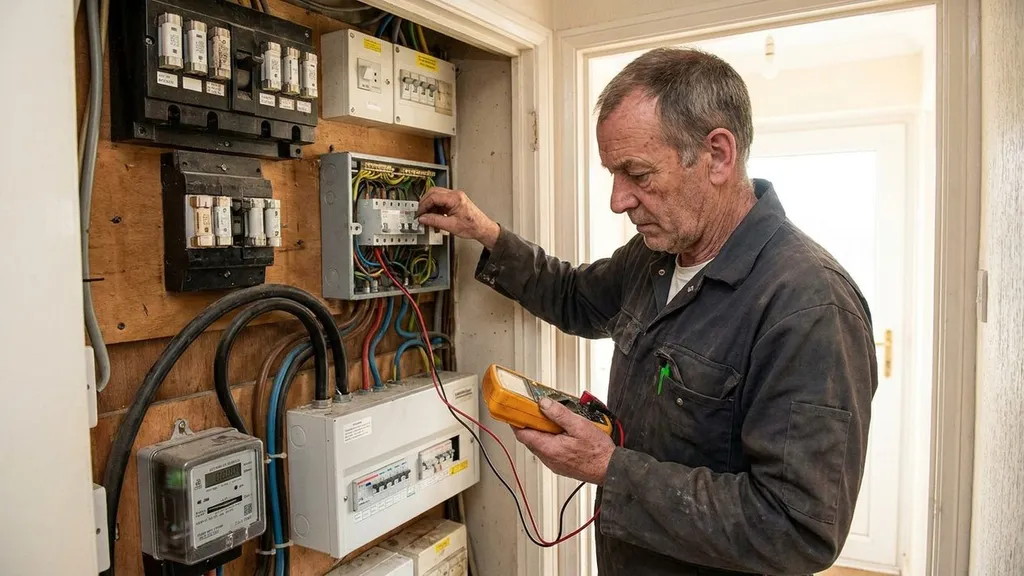
The short version: almost no UK home needs three-phase power. Around 95% of British homes run on single-phase, and single-phase comfortably handles a 7 kW EV charger, a heat pump and a solar array. Three-phase is sold as "future- proofing" for the all-electric home, but for most people it's an expensive answer to a problem they don't have. Here's how to check what you've got, the narrow cases where it genuinely helps, and what an upgrade really costs.
Single-phase vs three-phase, quickly
| Feature | Single-phase | Three-phase |
|---|---|---|
| Live conductors | 1 live + neutral | 3 lives (L1/L2/L3) + neutral |
| Voltage | ~230 V | ~400 V between phases (230 V per phase) |
| Main fuse | One fuse (typically 60–100 A) | Three fuses (often 100 A each) |
| Typical use | The vast majority of UK homes | Commercial, industrial, ~5% of homes |
| Max usable power | ~23 kW (100 A × 230 V) | ~69 kW (3 × 100 A × 230 V) |
The practical difference is simply how much power you can draw at once. A standard single-phase supply with a 100 A main fuse can deliver roughly 23 kW — more than enough to run a home, a heat pump and charge a car overnight, as long as you're not doing all the heaviest things at the exact same moment. Three-phase roughly triples that headroom.
How to tell which one you have
Find your main fuse — the sealed "service head" or cut-out where the supply cable enters your home, usually right next to the electricity meter:
- One main fuse = single-phase (this is almost everyone)
- Three fuses side by side (often 100 A each) = three-phase
Don't open the sealed service head — it's the supplier's equipment. If you can't tell from the outside, your meter readings or an electrician will confirm it.
You almost certainly don't need three-phase
The pitch is that electrifying your home — EV, heat pump, solar, induction hob — demands more power than single-phase can give. In reality it rarely does. A 7 kW EV charger, a single-phase heat pump and a domestic solar system all sit comfortably within a 100 A single-phase supply, and modern installs use load management (smart controls that briefly throttle the charger when the house is drawing a lot) to avoid ever tripping the main fuse — for a fraction of the cost of a supply upgrade.
When three-phase actually helps
There's a real list — it's just short. Three-phase is worth it if one of these applies:
- You specifically want a 22 kW EV charger — it physically can't deliver 22 kW on single-phase (see 22 kW vs 7 kW, where we explain why 7 kW is the right answer for almost everyone).
- You're installing a very large or multiple heat pumps (e.g. a big house or light-commercial load) beyond what single-phase comfortably supports.
- You want a large solar + battery system and need export headroom above the single-phase limits — though a G99 application can also get you there on single-phase.
- You run workshop machinery, a kiln, or agricultural equipment with three-phase motors.
- You're genuinely electrifying everything and your combined simultaneous draw would exceed ~100 A — rare in a normal household.
What an upgrade costs
Upgrading from single- to three-phase is a job for your DNO (Distribution Network Operator), not your energy supplier. Indicative UK costs:
- ~£1,800 minimum where three-phase already runs down your street
- £3,500–£7,000 typical, with some new cabling and a new service head
- £15,000+ if the network needs reinforcing (a new transformer or a cable pull from a distant feeder)
Timelines are 6–12 weeks minimum, and the homeowner pays — the DNO isn't obliged to fund a discretionary upgrade. That cost is exactly why load management usually wins: spending £5,000 on a supply upgrade to avoid the occasional brief throttle of an EV charger almost never pays back.
The single-phase generation limit (G98/G99)
One place three-phase genuinely buys headroom is exporting your own electricity. On single-phase, you can connect up to 3.68 kW of generation on a fit-and-notify basis (G98); above that needs DNO pre-approval via a G99 application. A three-phase supply spreads that across three phases — roughly 11 kW before G99 — which can matter for a large solar-and-battery install, but is overkill for a typical domestic system.
The "future-proofing" myth
It's tempting to upgrade "while the trench is open" or to be ready for whatever comes next. But the next domestic energy upgrades — bigger batteries, vehicle-to-home charging, smart tariffs — are overwhelmingly designed for single-phase homes, because that's what 95% of the country has. Unless you have a concrete, current need from the list above, the money is almost always better spent on the actual kit — a heat pump, solar or a battery — than on a supply you won't use.
Three-phase power FAQs
Can I get three-phase power at home in the UK?
Yes — but it is an upgrade you apply for through your Distribution Network Operator (DNO), not your energy supplier. Only around 5% of UK homes have a three-phase supply already. If three-phase cables already run down your street the job is relatively cheap; if the network needs reinforcing it can be expensive and slow.
How do I know if I have single or three-phase?
Look at your main fuse / service head (the sealed unit where the supply enters, usually next to the meter). A single-phase supply has one main fuse; a three-phase supply has three, often 100 A each, side by side. If in doubt, your meter or an electrician can confirm it — don't open the sealed service head yourself.
Do I need three-phase for an EV charger?
Only for a 22 kW charger. The standard 7 kW home charger (and 11 kW where the car supports it) runs perfectly well on single-phase — and 7 kW adds more than 100 miles of range overnight, which suits almost every household. Paying to upgrade to three-phase just to fit a 22 kW unit is rarely worth it.
Do I need three-phase for a heat pump or solar?
Almost never for a heat pump — the large majority of domestic air-source heat pumps run on single-phase. For solar and batteries, single-phase caps grid-tied generation at 3.68 kW under fit-and-notify (G98); above that you can still go single-phase via a G99 application, or use three-phase for more headroom. Most domestic systems never need three-phase.
How much does it cost to install three-phase at home?
Where three-phase is already in the street, UK Power Networks quotes a minimum of around £1,800. A typical realistic cost is £3,500–£7,000, and if the DNO has to reinforce the network (a new transformer or a cable pull from a distant feeder) it can reach £15,000+. Expect 6–12 weeks minimum, and the homeowner pays — the DNO isn't obliged to fund discretionary upgrades.
Is three-phase electricity more expensive to run?
No — you pay for the kWh you use at the same unit rate as single-phase. The cost is the one-off upgrade (and sometimes a slightly higher standing charge). Three-phase doesn't make appliances cheaper or more expensive to run; it just lets you draw more total power at once.
Sources & further reading
- What's the difference between a single-phase and three-phase supply? — UK Power Networks (DNO)
- Find my network operator (DNO) — Energy Networks Association
- Connecting generation — EREC G98 & G99 — Energy Networks Association
Editorial standards
How this guide was put together
Independent
Editorially independent UK guides — no sponsored content
Primary sources
Every guide cites gov.uk, Ofgem, MCS and manufacturer data
Current
Updated as schemes, prices and regulations change
Planning an EV charger, heat pump or solar?
Before you pay for a supply upgrade, get a quote — most installs work fine on single-phase.
Get Free Quotes